

Webinar: Quality Control in Coagulation Testing: Focusing on Results
“Internal quality control is an integral process of laboratory testing. A clinical laboratory’s coagulation quality control (QC) program is a critical component of its quality assessment program. The purpose of quality control in the laboratory is to detect, decrease, investigate, and help resolve deficiencies in a laboratory’s internal analytical process prior to the release of patient results, to improve quality of the results reported.…
Webinar: Mastering Your Migration Strategy With A DICOM Inventory
“Have you ever migrated data from one PACS to another? Ever had to plan a large data migration? DICOM migrations are complex and hard to manage. PACS Teams face challenges to minimize the cost to migrate images, to reduce the time needed to migrate, and to ensure all the data has been migrated.…
Webinar: Blood Cultures
“Sepsis due to bacterial bloodstream infection is a medical emergency that requires prompt clinical intervention. Blood cultures can confirm the etiology of infection and help direct appropriate antimicrobial therapy. The utility of blood cultures is highly dependent on specimen collection. For this reason, medical institutions monitor several indicators of appropriate blood culture collection to ensure high-quality specimens are submitted to the diagnostic laboratory.…
Invitation to Bid: Wastewater Laboratory Analysis Services
Solicitation #: 23-6800
“The City of Kenner Wastewater Department wishes to request bids for laboratory testing services for a period of three (3) years. The scope of services will include all labor, materials, tools, shipping, all sample containers, equipment, and facilities required for analysis, report preparation, and electronic transfer of data to the City of Kenner.…
Quality control in the clinical biochemistry laboratory: A glance
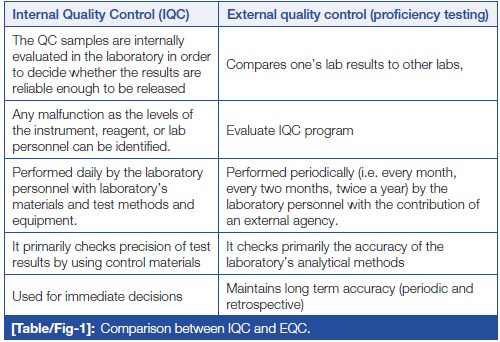 In this 2023 article published in Journal of Clinical and Diagnostic Research, Naphade et al. provide a brief introductory-level review of the importance of quality control (QC) to the clinical laboratory. After a brief introduction on clinical lab testing, the authors analyze the wide variety of sources for laboratory errors, covering the pre-analytical, analytical. and post-analytical phases. They then introduce the concept of quality control, followed by explaining how QC is implemented in the laboratory, including through the use of QC materials, statistical control charts, and shifts and trends. They conclude this review by stating that "reliable and confident laboratory testing avoids misdiagnosis, delayed treatment, and unnecessary costing of repeat testing." They add that given these benefits, "the individual laboratory should assess and analyze their own QC process to find out the possible root cause of any digressive test results which are not correlating with patients' clinical presentation or expected response to treatment."
Invitation for Bids: Whole Effluent Toxicity, Tox, and GC/MS Laboratory Testing Services
Solicitation #: 87 – 23
“Jefferson County, Alabama d/b/a Jefferson County Environmental Services Department desires to enter into contract with a bidder for Whole Effluent Toxicity testing, Total Organic Halogen (TOX) testing, volatile and semi-volatile organic compounds, and other laboratory testing services as required by Environmental Services per the latest approved EPA testing methods.…
Request for Proposal: Surgical Pathology, Cytology, and Clinical Laboratory Services
Solicitation #: 325-23-900-074
The State of North Dakota is seeking proposals for a variety of clinical “laboratory services for the North Dakota State Hospital in Jamestown, North Dakota.”
Due date: 09 November 2023, 3:00 p.m. CST…
Webinar: Is PHI compliance driving your cloud strategy?
“With over 80% of patients saying they are concerned about their protected health information (PHI), it’s no longer just an IT concern. But you shouldn’t have to choose between compliance and innovation. With insights from CTOs within the healthcare industry, learn how you can augment stretched-thin resources and prevent, detect and respond to risks proactively—allowing you to think bigger when it comes to your healthcare-focused cloud infrastructure.…
Webinar: Next Step in Automating Clinical Genomics: Addressing Liquid Handling Bottlenecks in Cancer Panels, Rare Diseases, and NIPT
“The clinical laboratory for in vitro diagnostics is facing pressure these days to keep costs down whilst pressure increases to provide high quality services for more samples.
Typically, clinical genomics labs resort to purchasing multiple liquid handlers or hiring and training more staff to cope with the increased testing demand.…
Invitation to Bid: Laboratory Services for Protozoa and Biological Analysis
Solicitation #:
The City of Cleveland, Ohio’s Division of Water is seeking laboratory services for the analysis of protozoa and other biological samples. See the documents for more.
Due date: 09 November 2023, 12:00 p.m. EST…
Webinar: Battery material changes in real-time: silicon anode structural evaluation via isothermal microcalorimetry
“From cutting-edge cars to appliances in the home and ones you wear on your wrist, battery technology is evolving rapidly, racing to keep up with consumer and industry demands. Understanding battery chemistry is essential in battery research that could hold the key to enhancing both technological efficiency and how we live our lives.…
Laboratory Informatics Weekly Update – Volume 21, Issue 45
November 9, 2023 Laboratory Informatics Weekly Update Volume 21, Issue 45 In This Issue Announcements 10/30/2023 - LiMSforum is pleased to offer LiMShelp consulting to our laboratory members at no chargeLiMSforum publishes the LiMSpec to help your laboratory develop your LIMS requirements. Today, LiMSforum now provides free LIMS consulting services to our laboratory members to help utilize the LiMSpec to capture all of the laboratory user requirements specifications (URS) and to develop a set of requirements that reflects the LIMS needs specific to your lab. To learn more about this offering, please click here. Featured Books LIMS Selection Guide…Request for Proposals: Laboratory Information Management System for Mississippi Department of Environmental Quality.
Solicitation #: 1601-24-R-RFPR-00004
Mississippi Department of Environmental Quality (MDEQ) “has a laboratory located in Pearl, MS, which employs scientists and analysts who examine water samples, soil samples, and other environmental elements to determine the levels or absences of contaminants. The Laboratory Information Management System (LIMS) is the system used to manage and correlate the data to make these determinations.…
How does a cybersecurity standards framework fit into a laboratory’s cybersecurity plan?
 An effective cybersecurity plan is imperative for any laboratory, given the often sensitive nature of the data it manages. A cybersecurity standards framework can help labs develop a complete, effective, affordable cybersecurity plan while keeping the laboratory’s expertise in testing and analysis, not the vast and constantly evolving landscape of cyber risks. [Read More]
QLIMS Case Study: Confectionery Brand
 In this LIMS case study, we delve into how one of the world’s leading confectionery brands faced challenges and how QLIMS has worked to bring the highest levels of testing for their raw and packaging materials. [Read More]
The Potent Combination of ELN and LIMS: The Fast-Track from Ideation to Commercialization
 Rooms filled with boxes of laboratory notebooks to the brim. Scattered Post-it notes and Excel sheets. It may sound like a chaotic scene of a mad scientist’s lab, but these things may be all too familiar to the modern-day R&D researcher. The struggle R&D researchers face today is real: while great leaps in science and technology have been made over the last few decades, lab technology hasn’t kept pace with the needs of modern researchers. Enter Electronic Lab Notebooks (ELN) and Laboratory Information Management Systems (LIMS)... [Read More]
ELN vs LIMS vs LIS Solutions
 Over decades, many different types of software have been developed to facilitate the scientific research and testing processes that occur in all different types of laboratory settings. The results is a cluster of acronyms and abbreviations that causes a lot of confusion amongst those trying to determine what will best support their specific needs. In this article we hope to provide helpful guidance by explaining what an ELN, a LIMS, and a LIS do, the environments they’re best suited for, and shed light on the current state of laboratory informatics technology. [Read More]
What are the key elements of a LIMS for clinical diagnostics?
 In clinical diagnostics, laboratories that expect to stay ahead must embrace cutting-edge technologies while adhering to regulatory obligations. A LIMS streamlines operations and positions labs at the forefront of diagnostic excellence is necessary. A LIMS for clinical diagnostics labs is a multifaceted solution that combines sample management, data management, stringent quality control, seamless integration, user management, and regulatory compliance. [Read More]
For a 3rd Year Running, L7 Informatics Joins the Winner’s Circle Again, Making the 2023 Deloitte Technology Fast 500™
 L7 Informatics today proudly announces its inclusion in the prestigious Deloitte Technology Fast 500™, for the third consecutive year. This accolade celebrates the company's extraordinary 2047% revenue growth, a testament to its groundbreaking approach and unwavering commitment to the life sciences sector. [Read More]
Webinar: The Ever-Changing Landscape of Laboratory Informatics
“Laboratory informatics, as a topic, encapsulates the mundane (software to instrument communication) to the exotic (data science and artificial intelligence). In this presentation we’ll describe the early history of laboratory informatics; review autoverification case studies where medical laboratory professionals played a major role in the implementation; and discuss future projects and the involvement of medical laboratory professionals.…

