Posted on August 27, 2026
By Kalleid
Blog, Featured Content

Our team attended the July 29, 2026 PHUSE webinar, “Building a Trustworthy RWD Analytic Platform,” presented by SAS. The session highlighted modern RWD/RWE architecture considerations. Below is our perspective on the webinar’s key themes and how Kalleid supports validation of RWD analytics environments, with a focus on reproducible, compliant, transparent, and audit-ready outputs.
[Read More]
Posted on August 27, 2026
By Kalleid
Blog, Featured Content

Modern drug discovery relies on vast amounts of proprietary data, making R&D environments prime targets for cyber threats. Protecting genomics, screening, clinical, and AI-driven systems requires more than traditional defenses. Domain-aware cybersecurity is essential for safeguarding IP, data integrity, and research continuity.
[Read More]
Posted on August 24, 2026
By LabLynx
Blog, Featured Content

A LIMS is easy to buy but difficult to implement. Success depends on decisions made early—often before a contract is signed. A LIMS makes the sample the unit of record, linking every transfer, method, instrument reading and approval in a traceable history. How well it works ultimately depends on four key decisions made before purchase.
[Read More]
Posted on August 24, 2026
By ELabELN
Blog, Featured Content

Lab automation pays when a task is high volume, low judgement and methodologically stable. When any condition is missing, exceptions can erase the savings. That’s why candidate selection matters more than technology choice. Labs often prioritize tasks by how annoying they are—a poor predictor of automation’s return.
[Read More]
Posted on August 21, 2026
By CSols Inc.
Blog, Featured Content

This white paper explores common data visualization techniques for biotechnology and pharmaceutical laboratory settings, with examples of how different data sets can be communicated visually. Designed for stakeholders in Canada, it provides practical ideas for presenting complex laboratory information clearly and enabling faster understanding at a glance.
[Read More]
Posted on August 21, 2026
By Astrix Technology Group
Blog, Featured Content

As FDA’s QMSR became mandatory in 2026, biopharma organizations face growing pressure to modernize and securely migrate laboratory data. This article outlines a regulatory-first framework for validated, AI-ready data migration that protects data integrity, minimizes downtime, supports evolving LDT oversight, and reduces compliance and breach risks.
[Read More]
Posted on August 21, 2026
By Kalleid
Blog, Featured Content

Drug discovery has evolved from an empirical, wet-lab discipline into a data-driven enterprise powered by AI, genomics, CRISPR, and multi-omics. As life sciences harness massive datasets to accelerate discovery, a key challenge remains: finding analytics talent with the specialized expertise needed to turn data into breakthroughs.
[Read More]
Posted on August 17, 2026
By CSols Inc.
Blog, Featured Content

CSols is hiring a Junior to Mid-level SampleManager LIMS Configuration SME/Developer (Remote, US or Canada) with Business Analyst experience. The role involves gathering client requirements, configuring SampleManager LIMS (Workflows, Forms, C#, VGL), integrating instrumentation and systems, and providing user training and support.
[Read More]
Posted on August 17, 2026
By Kalleid
Blog, Featured Content

Kalleid's case study shows how 3 embedded engineers helped a global biopharma tackle data fragmentation and slow target evaluation by building an agentic AI platform. Results included Okta authentication, expanded discovery criteria, multi-specific visualization tools, and an LLM testing framework.
[Read More]
Posted on August 17, 2026
By Astrix Technology Group
Blog, Featured Content

Astrix outlines the shift from siloed clinical operations to a unified, interoperable stack built on four pillars: EDC, CTMS, eTMF, and IRT. With ICH E6(R3) and CSA-style validation reshaping compliance expectations, the guide covers decentralized trials, ALCOA+ data integrity, and AI governance for 2026.
[Read More]
Posted on August 17, 2026
By SciY
Blog, Featured Content

For small and medium-sized laboratories, the benefits of a LIMS are often immediate: fewer duplicate entries, less time spent chasing sample status, faster reporting, more consistent execution, and stronger audit readiness. Want to build the business case? Our experts can help you create a personalized analysis tailored to your lab’s needs.
[Read More]
Posted on August 17, 2026
By CSols Inc.
Blog, Featured Content
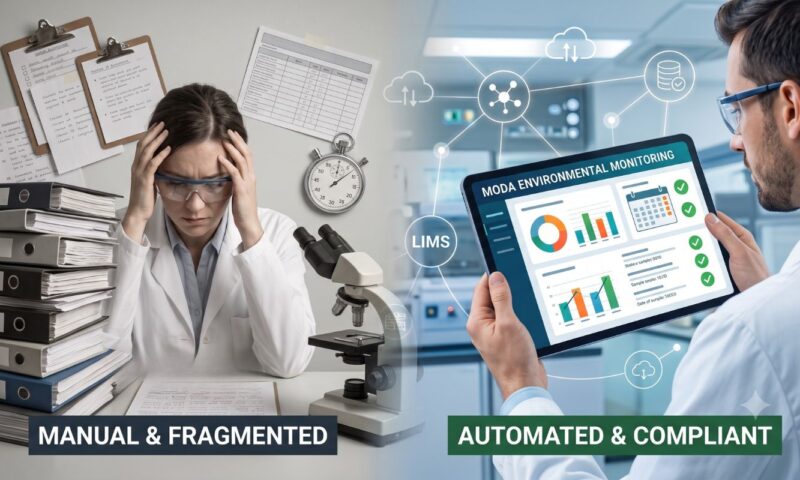
MODA-EM transforms lab environmental monitoring from a compliance burden into a strategic advantage, enabling paperless data collection, real-time trending, and instrument integration. CSols highlights where expert laboratory software consulting boosts implementation, ensures regulatory compliance, and streamlines reporting for QC microbiology teams.
[Read More]
Posted on August 10, 2026
By LabLynx
Blog, Featured Content

Most LIMS business cases open with an industry-average savings percentage, and the conversation becomes an argument about whether that number applies to your lab. Here is the other approach: four current-state cost lines you can pull from your own records in an afternoon, the five figures to demand from any vendor in writing, and the formulas.
[Read More]
Posted on August 10, 2026
By LabLynx
Blog, Featured Content

Six dated entries, each with current status. The FDA's LDT rule is vacated, not delayed. The BIOSECURE Act is law but not yet operative. And ISO/IEC 17025 was not revised in 2025, despite widespread reporting to the contrary. The next hard date is 18 December 2026, and most of these frameworks ask for the same four records.
[Read More]
Posted on August 7, 2026
By CSols Inc.
Blog, Featured Content
Join CSols Inc., a premier laboratory informatics consultancy trusted by global biotech, pharma, and chemical companies to modernize lab data management. We're seeking a talented LabVantage Developer to design, build, and deliver LIMS solutions spanning data migration, configuration, validation, and support across regulated and non-regulated environments. If you thrive at the intersection of science and technology, we want to hear from you.
[Read More]
Posted on August 7, 2026
By Kalleid
Blog, Featured Content

Kalleid partnered with the Pistoia Alliance to design a standardized framework for capturing and communicating project value. The three-phase engagement delivered a Benefit Capture Template, marketing-ready pitch deck, and streamlined process flow, improving funding predictability, steering committee transparency, and visibility into project outcomes.
[Read More]
Posted on August 7, 2026
By CSols Inc.
Blog, Featured Content
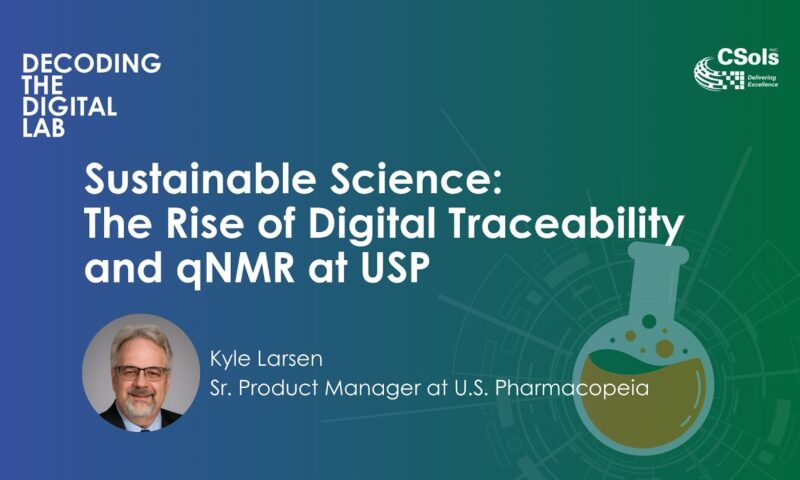
Host Becky Stewart sits down with Kyle Larsen of the United States Pharmacopeia to discuss the shift toward digital reference standards and the launch of USP Method Connect. A must-listen for lab managers and scientists looking to bridge legacy paper-based systems with modern, automated qNMR workflows and digital traceability.
[Read More]
Posted on August 7, 2026
By Astrix Technology Group
Blog, Featured Content

Clinical trial oversight has long meant reconciling separate views: Clinical Ops, Data Management, Medical Monitors, and Biostatisticians each working from their own reports. Astrix explores how a centralized Data Quality Oversight Interface, powered by AI-led curation and agentic automation, unifies these roles into one real-time view of trial health, cutting the lag between signal and action.
[Read More]
Posted on August 3, 2026
By ELabELN
Blog, Featured Content

Inspectors do not start with the result. They start with one record and ask what happened to it. ELabELN walks through a single method qualification run with eight audit trail entries, showing which ones hold up, which one triggers an observation, and why the configuration entries most labs skip are the ones reviewers read first.
[Read More]
Posted on August 3, 2026
By LabLynx
Blog, Featured Content

EPA has proposed pushing PFAS treatment compliance to 2031 and rescinding four of the six regulated analytes, but neither proposal moves the monitoring date. Initial results are still due to the state by April 26, 2027. LabLynx breaks down the sampling schedules, what UCMR 5 data can still count for, and where the deadline actually gets missed.
[Read More]


