
A picture is worth a thousand words. This adage is common in numerous languages today, but it originated in Norway with
Henrik Ibsen, the playwright, whose original quote was “A thousand words leave not the same deep impression as does a single deed.” Over the last hundred years, it has evolved to the form many of us are familiar with. And today, labs everywhere are discovering how true this statement is for their lab data analytics.
[Read More]

If your lab is considering investing in a laboratory information management system (LIMS), you might be wondering what exactly the process looks like. Implementing a LIMS is a complex undertaking, but if you know what to expect from such a project, it makes tracking its progress and directing the entire process more manageable.
[Read More]

LIMS projects are normally both high profile and of relatively high cost to an organization. This means that Project Managers want to get the best solution at a price within their budget but at the same time making the minimal amount of compromises to the original solution envisaged at the outset of the project. If this balancing act is carried out efficiently then the company will have achieved the best Return on Investment (ROI) possible. Achieving a maximized ROI does not always mean that the system will have 100% of the originally envisaged functionality.
[Read More]

Wastewater surveillance is becoming an increasingly important component of human health monitoring.
In 1854, wastewater testing in London revealed the source of the city’s cholera outbreak. Nearly a century later, scientists used wastewater as part of the detection and eradication strategy against polio. Over time, pathogen testing of wastewater has expanded from a handful of analytes to a complete compendium of chemistries, microbiology, and most recently, virology.
[Read More]
During the first week of August 2022, the Houston Astros played the Red Sox in Fenway Park. Christian Vazquez had been a catcher playing on that field since 2014. On August 1, he found himself playing on the same field but in a different uniform, that of the Astros. He had been traded just as the series was going to start; this change elicited a reaction of “baseball is a business”. Change is one of those things we all have to deal with, and a good approach to it requires constant preparation.
[Read More]
 Structured Content Authoring
 (SCA) is a standardized method where technical content is controlled by pre-defined guidelines. The technical writer marks up the content according to what it semantically represents and agreed guidelines. The writer is not concerned with editing styling or formatting. The idea is to develop discoverable, reusable, adaptable, reconfigurable templates for storing, tagging, standardizing, and translating critical content.
[Read More]

Laboratories are rapidly adapting to latest technologies for a variety of reasons like: High quality standards, Stringent regulatory norms set by industry governing bodies, Standard operating procedures, Need for better control over workflow & processes, High standards to maintain data security & data integrity, Need for higher productivity due to increasing cost & workload
[Read More]

With 2022 seemingly finishing just as fast as it arrived here are the upcoming events that you can meet either the OnQ Software team or one of our esteemed partners
[Read More]

Many research and development centers increasingly generate and process massive amounts of data. As such, because of the volume and processing of data, in addition to the advancement of technology, laboratories need to upgrade their laboratory management and technology strategies to improve operations and minimize costs.
Within regulated labs, there has been a significant emphasis on data protection in recent years. Many of the control systems put in place to ensure safety or minimize concerns, however, are not real-time.
[Read More]

Data integrity refers to the overall completeness, accuracy and consistency of data during its entire life cycle. Though seems simple, the whole process of genuinely generating, maintaining & transforming data with completeness and accuracy is a challenging task for any organization. This white paper discusses the issues faced by organizations in achieving data integrity and briefly describes how and what technology can be effectively used to achieve better data integrity.
[Read More]

The history of laboratory informatics began in earnest with the commercialization of instrument data systems and
LIMS software, the latter having the larger impact since it could affect the entire lab’s productivity and benefit the organization it supports. That software found a home in both industrial Research & Development,
Manufacturing, and
Healthcare (clinical laboratories). In each of these situations, LIMS provided a means of organizing and managing testing workflows and streamlining operations.
[Read More]
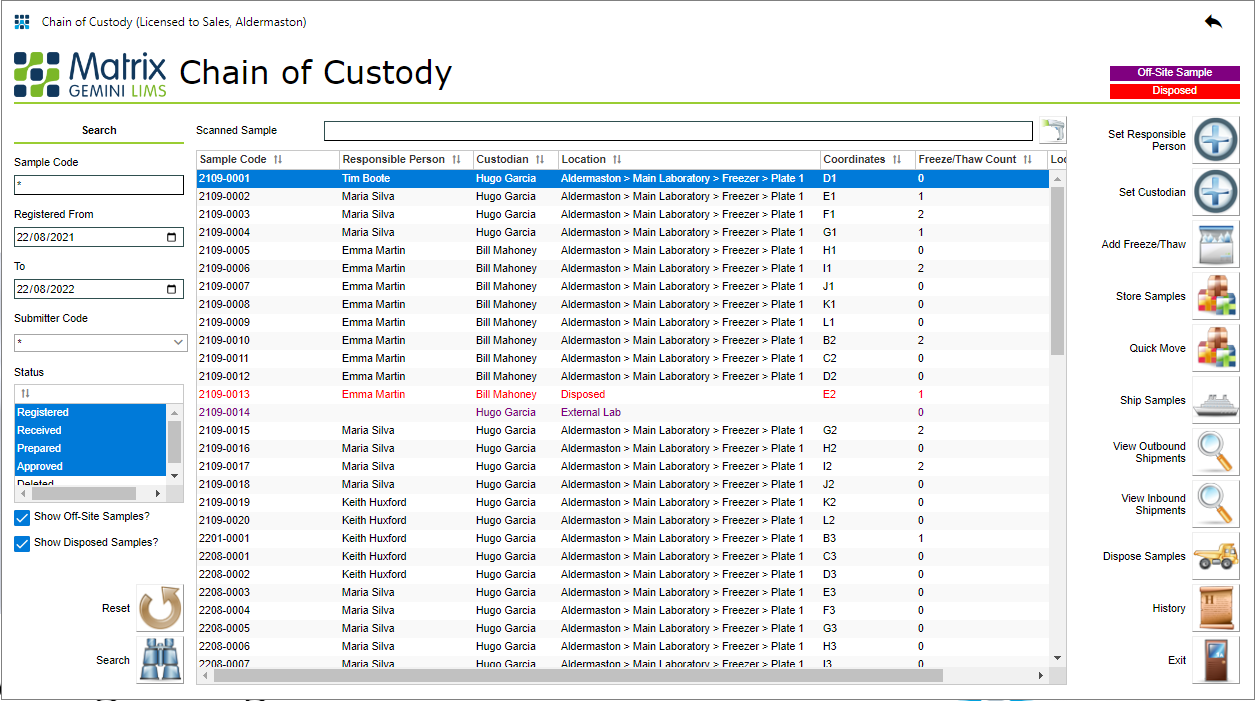
Automatically recording the Chain of Custody (CoC) for an item is essential when it is necessary to track an item throughout its lifetime. A CoC will, for example record the location of an item, showing where it is now as well as where it has been. A comprehensive CoC, however, must record more than just the location history of an item; for example, it can be important to know who is, and who has been, responsible for an item during its lifetime.
[Read More]

In the modern industrial era, data sharing provides a great stimulus to scientific advancement by enhancing transparency, improving collaboration, accelerating research and driving better decision-making. In areas such as public health, data sharing is very vital and critical during emergency situations such as outbreaks of infectious diseases.
[Read More]

The biopharmaceutical industry can become sustainable. Several leading drug developers are determined to achieve net zero carbon emissions within the next 25 years and are enhancing efficiency in all aspects of their operations to meet this goal. In the lab, using a lab information management system (LIMS) to track and manage assets, data and reports is one way to do that.
[Read More]

In today’s job market, where candidates have more choices than ever before, companies must focus on creating a positive and fast hiring process.
How can you improve your hiring process? Below are questions that will help you identify areas where your process may need improvement.
[Read More]

Your laboratory’s total testing process begins and ends far beyond your laboratory’s walls. Sources of human error can creep into your test results at many points along the process chain. Yet, as our guide “
Improve Laboratory Accuracy and Reporting Quality with a LIMS” notes, people often forget the importance of the final step: your customers’ interpretation of the results. This article addresses how
LabLynx LIMS software can help you design better, more readable reports to, in turn, help your customers make better decisions.
[Read More]

Straight on the heels of a
COVID resurgence this summer, US laboratories are bracing for yet another swing in their seemingly ever-changing staffing and resource needs to address new clinical and wastewater testing for human monkeypox virus (hMPXV).
[Read More]

Data Fabric is a hot topic buzzword today. We think of Data Fabric as the way of creating an abstraction from the underlying technology. Allowing the data to be exposed at the top level as business objects that are semantically related. This can be thought of as a weaving together of data from internal silos and external sources that creates a network of information to power the business’ applications, AI, and analytics.
[Read More]

Electronic Laboratory Notebook (ELN) plays a vital role in the laboratories in the areas of bench level analysis, and point of analysis by providing real-time automation and control of testing procedures. Cloud-based ELNs ensure that procedures are carried out in an automated manner by the way direct integration with instruments (i.e. data is collected directly from instruments), the computations are performed, and inventory is checked and updated.
[Read More]

Develop Effective Training for your Pharmacovigilance System. Conduct it Early. Employee participation in training–prior to go-live of your Pharmacovigilance System–is critical to enhancing comfort key to realizing the full benefit of a new software system. Software training for your pharmacovigilance system is most effective when it is focused on the end-user position.
[Read More]


