

Webinar: Time to get off the BANDwagon: A Critical Re-appraisal of Band Enumeration
“Band enumeration is entrenched in laboratory practice, with over 86% of recently surveyed labs enumerating bands. A critical evaluation of the test characteristics is presented that demonstrate its limited clinical utility. Current evidence based clinical practice guidelines (e.g., from the American Association of Pediatrics for neonatal sepsis) do not include band counting in management algorithms.…
Webinar: Trust on the Line: Protecting Your Brand in a World of Food Safety Hazards
“The recent recall of lead-contaminated applesauce and cinnamon products highlights the importance of proactive food safety risk management. It is critical for food companies to prevent food safety issues to ensure product safety, maintain consumer trust and protect brand reputation, but identifying and prioritizing these supply chain risks can be a challenge without the right strategy.…
LAB-SUPPLY 2024 Regional Fair – Berlin
An annual regional trade fair for instrumental analytics, laboratory technology, laboratory chemicals, and biotechnology…
FAIR and interactive data graphics from a scientific knowledge graph
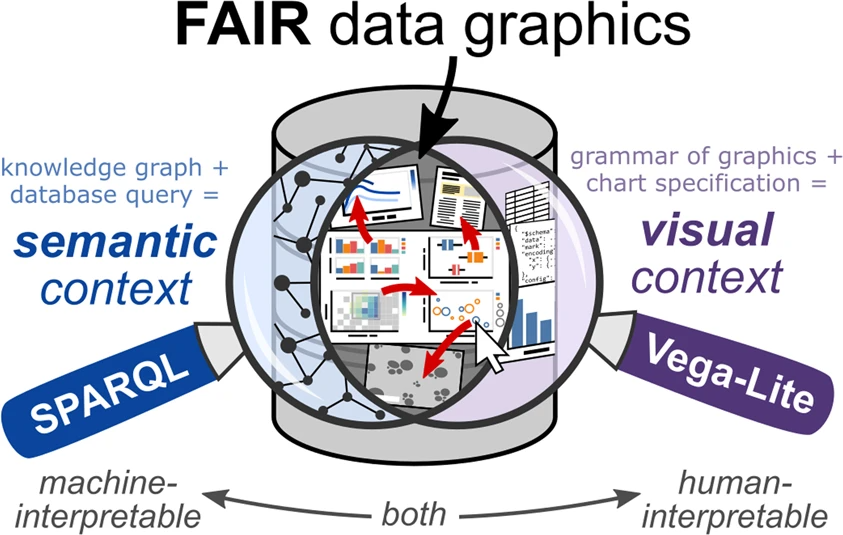 In this 2022 paper published in the journal Scientific Data, Deagen et al. present their approach to "web-based, interactive data graphics synchronized to a knowledge graph" in order to make materials science research objects more FAIR (findable, accessible, interoperable, and reusable). After a brief introduction, the authors discuss their methodology and results towards representing charts as metadata, tapping into SPARQL, Vega-Lite, and knowledge graph databases. They also address how their method touches upon multiple aspects of the FAIR data principles. They conclude that "altogether, this pairing of SPARQL and Vega-Lite—demonstrated here in the domain of polymer nanocomposite materials science—offers an extensible approach to FAIR ... scientific data visualization within a knowledge graph framework," adding that "defining charts as metadata in a knowledge graph captures semantic context and visual context while providing interactive, human-interpretable documentation of the contents of a knowledge graph."
Request for Statement of Qualifications: Construction Material Testing Services and Forensic Investigation and Evaluation of In-place Construction Materials for the 365 Tollway Project
Solicitation #: 2024_05
“The Hidalgo County [Texas] Regional Mobility Authority is seeking qualified material testing laboratories to conduct destructive and non-destructive testing for a heavy highway transportation project. The project includes the construction of bridges, foundations, retaining walls, base materials, and associated infrastructure.…
Request for Information: Acquisition of a laboratory information management system for the University of Montreal Veterinary Diagnostic Center (CDVUM)
Solicitation #: UDEM2500 / 1855345
The University of Montreal Veterinary Diagnostic Center (CDVUM; Centre de diagnostic vétérinaire de l’Université de Montréal) is requesting information about laboratory information management system (LIMS) options that meet their requirements. NOTE: Log-in required to view the document.…
LabWare 2024 European Customer Education Conference

An annual LabWare customer education conference for the European region
NOTE: As of October 2023, venue not announced, but in Rome, Italy.…
Webinar: New Research: The State of Healthcare Cloud Security and Compliance Posture
“75% of healthcare CISOs and CIOs report that meeting security and compliance measures competes with scaling innovation and growth. The recent Change Healthcare and Ascension Healthcare breaches demonstrate that even baseline levels of compliance and security debt within a healthcare organization can lead to detrimental patient outcomes and a monstrously negative fiscal and brand reputation impact.…
Webinar: Pathology + DICOM: A Picture-Perfect Pairing
“Explore the potential of DICOM (Digital Imaging and Communications in Medicine) in shaping the future landscape of digital pathology. In this session, we will delve into the practical applications and advantages of DICOM standards in streamlining image management, facilitating interoperability, and enhancing collaboration within the field of pathology.…
Webinar: Using Digital and Automated Food Safety Testing to Inform Risk
“Evaluating hazards and risks assessments are critical tools for food safety professionals developing and following their food safety plans. Risk scores can be developed using the expertise of your team, providing their perception of risk from their perspective and experiences. Though valuable, a risk scoring exercise based solely on perception is only capable of yielding a “perceived risk” score.…
Webinar: On the Duality of Metadata: Potential Uses and Abuses of Provenance Information
“In the past decade, critical internet studies scholars and disinformation researchers have discovered how metadata can be exploited to craft deceptive narratives and influence public discourse on platforms. This talk explores some tactics used by bad actors to manipulate social media platforms and evade content moderation by obfuscating provenance information; highlighting the importance of metadata in identifying disinformation and current responses managing the risks of deceptive content spread across platforms.…
Request for Proposals: Environmental Field Sampling and Laboratory Testing
Solicitation #: 240029
“The Niagara Frontier Transportation Authority (NFTA) and Niagara Frontier Transit Metro Systems, Inc. (NFTM) hereby seeks proposals that meet the qualifications set forth herein to perform Environmental Field Sampling and Laboratory Testing. The purpose of field sampling and the subsequent lab test result analysis is to assess compliance with both regulations and permitted limits applicable to the NFTA/NFTM.”…
Webinar: From Concept to Market: How AI is Reshaping Polymer Production
“To meet shifts in customer and market demands, supply chain volatility, and emerging regulatory and sustainability initiatives, leaders in Polymers have adopted Artificial Intelligence (AI) to accelerate product ideation, deployment, and scaling.
Join Dr. Steve Edkins (Director of Data Science and Data Engineering at Citrine Informatics) for an informative session on the modern challenges faced by compounders and resins and additives producers alike, and how they are leveraging AI.…
Laboratory Informatics Weekly Update – Volume 22, Issue 24
June 13, 2024 Laboratory Informatics Weekly Update Volume 22, Issue 24 In This Issue Featured Books LIMS Selection Guide for ISO/IEC 17025 Laboratories Featured Content The Lab’s Secret Weapon: How LIMS Transforms Food Testing Efficiency and Waste ReductionLabLynx's Laboratory Information Management System (LIMS) revolutionizes food testing labs by automating workflows, centralizing data, and optimizing inventory management. This leads to reduced manual errors, improved sample tracking, and efficient resource allocation, ultimately increasing productivity and minimizing waste. [Read More] What Are the Four Core Functions of a LIMS System?When you’re considering implementing a Laboratory Information Management System (LIMS) system in your…Request for Proposals: Environmental Sample Analysis
Solicitation #: FAC-01454-RFP
“The University of Texas MD Anderson Cancer Center (MD Anderson) is hereby contracting for laboratory services. The services are for analysis of mold, bacterial, United States Pharmacopeia (USP) 797, Asbestos, and Legionella samples. The samples are collected from air, water, and surfaces.…
The Lab’s Secret Weapon: How LIMS Transforms Food Testing Efficiency and Waste Reduction
 LabLynx's Laboratory Information Management System (LIMS) revolutionizes food testing labs by automating workflows, centralizing data, and optimizing inventory management. This leads to reduced manual errors, improved sample tracking, and efficient resource allocation, ultimately increasing productivity and minimizing waste. [Read More]
What Are the Four Core Functions of a LIMS System?
 When you’re considering implementing a Laboratory Information Management System (LIMS) system in your lab, there are many elements that you must consider. This includes understanding how the LIMS system will affect, or instead benefit, the lab. By knowing more about the four core functions of a LIMS, it will be easier to understand how it will fit into the lab and the advantages you can expect. [Read More]
RenBio Reimagines Antibody Therapeutics with the Labstep ELN from STARLIMS
 RenBio reimagines the way antibody therapeutics can be produced and delivered by creating a delivery platform that takes advantage of the body’s ability to produce any given antibody or therapeutic protein when provided with a precise set of genetic instructions. Learn how RenBio has transformed their R&D lab operations, by securely centralizing all research data within the Labstep ELN from STARLIMS. [Read More]
Leveraging LIMS for Advancing Cellular Therapies
 Cellular therapies are a groundbreaking approach to medicine that utilises living cells to treat various diseases and conditions. Unlike traditional pharmaceuticals, which often target symptoms, cellular therapies aim to address the underlying causes of disease by delivering living cells or modifying a patient’s cells to restore or enhance their function. Cellular therapies hold immense promise for personalised and precise treatments, offering new hope to patients with conditions previously considered untreatable. [Read More]
Embracing Sustainability: Pioneering a Greener Future for Your Lab with Innovative LIMS Solutions
 Want to make your lab more sustainable? LabLynx LIMS helps you go green by optimizing resource management, reducing waste, and automating energy-intensive tasks. Join the movement towards a more eco-friendly lab and make a positive impact on the environment with LabLynx. [Read More]

