

LIMS – Buy or Build?
LIMS – Buy or Build?
Many laboratory directors from different disciplines have asked this one question regarding LIMS: “Should we buy a LIMS or build our own?” In the early 90s and into the mid-2000s, it was not uncommon for a laboratory to create their own LIMS from scratch rather than using the commercially available options. Upon occasion, those laboratories would purchase an open source code LIMS and then hire programmers to make that LIMS their own.Genohm at the ISBER 2016 Biobanking Conference in Berlin
Freezerworks Founder and System Architect honored for Service to International Biobanking
Genohm at the ISBER 2016 Biobanking Conference in Berlin
Laboratory Informatics Weekly Update – Volume 14, Issue 11
March 16, 2016 Laboratory Informatics Weekly Update Volume 14, Issue 11 In This Issue Webcast Focus WEBINAR - ELN Phase 2: Broadening the Utilization of Your R&D ELN Wednesday, March 23, 2016 at 2:00pm EDT Now that you have used your ELN for some time and have gained more experience, it is a good time to take a step back, set some new goals, and analyze how your current ELN can be enhanced and expanded to meet those goals. Now is the time to start thinking about what’s next! Cahier de Laboratoire Électronique (ELN) Phase II: Élargir l’utilisation 24 mars…Visiopharm Powers Up With VIS 6.0
NG6: Integrated next generation sequencing storage and processing environment
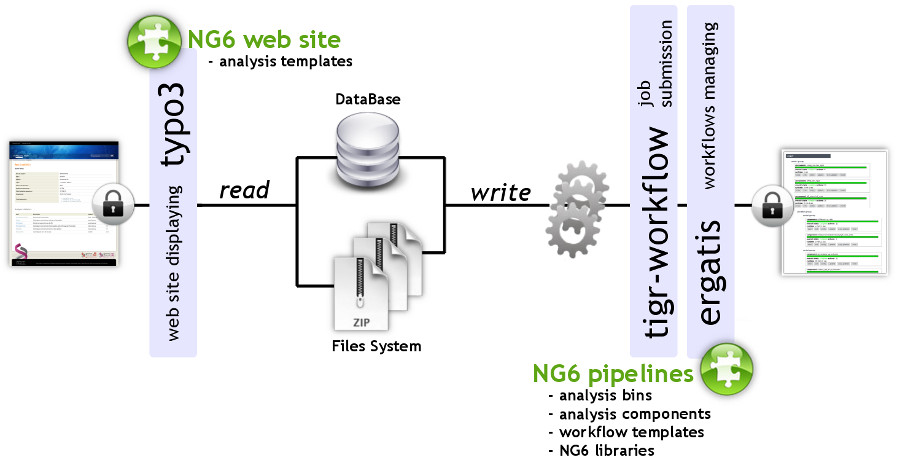 Published in 2012, this paper on the NG6 next generation sequencing (NGS) platform describes the software's development process at GenoToul, a French shared life sciences research facility. Mariette et al. found that NGS software Galaxy was promising but not sufficient as it only "aims at simplifying data processing for researchers," whereas the group needed a LIMS that was also good at "gathering specialized pipelines and website" data. NG6 was developed to meet that need.
Omnyx, LLC Introduces New Dynamyx™ Software for Exceptional Digital Pathology User Experience
STATegra EMS: An experiment management system for complex next-generation omics experiments
 Hernández-de-Diego et al. from the Centro de Investigación Príncipe Felipe and the Karolinska Institute needed a softwar that " [i]n contrast to other solutions that put the focus on management of thousands of samples for core sequencing facilities ... [could handle] the annotation of experiments designed and run at individual research laboratories." Additionally, genomics solutions such as BASE had annotation limitations in regards to microarray experiment data. The group decided to develop their own system called the STATegra experiment management system (EMS), which they concluded "provides an integrated system for annotation of complex high-throughput omics experiments at functional genomics research laboratories."
XIFIN to Unveil Expanded Diagnostic-Based Collaboration and Clinical Data Management Platform at USCAP Annual Meeting
Veritomyx Launches PeakInvestigator™ Software Services to Detect and Report Previously Hidden Mass Spectrometry Data
PDS Life Sciences Launches SEND Express™ to Help Companies Convert Data to Meet New FDA Standards
Digital Pathology Solution Provider, Inspirata, Announces Interface to Address Interoperability Challenges in Cancer Center Pathology Departments
Sectra: Improved Cancer Care Through Interface between Sectra’s Digital Pathology Solution and Dutch LIMS Provider Finalist
Agilent Technologies Launches New Platform for Analyzing Cell-Free DNA
How to Create Solid User Requirements for a System Application
How to Create Solid User Requirements for a System Application
"A house is only as strong as its foundation" - for a Laboratory Informatics solution (e.g. LIMS, ELN, CDS), the foundation for an implementation is the User Requirements document. Make sure that you have a strong and solid foundation before you implement.New Instruments and Software Designed to Improve Trace Elemental Analysis
An Introduction to Next Generation Sequencing
An Introduction to Next Generation Sequencing
 The high demand for low-cost sequencing has driven the development of high-throughput sequencing, which is also termed as Next generation sequencing (NGS). Thousands or millions of sequences are concurrently produced in the next-generation sequencing process. Next generation sequencing has become a commodity. With the commercialization of various affordable desktop sequencers, NGS will be of reach to more traditional wet-lab biologists .
Drawing from the obvious goodwill and community spirit displayed on discussion forums, and exploiting the collaborative tools made available by the Wikimedia foundation, this free ebook: http://www.limsbook.com/an-introduction-to-next-generation-sequencing/1844/ is designed to initiate the editing of a collaborative WikiBook on NGS. Ultimately, our goal is to create a collective lab book that explains the key concepts and describes best practices in NGS.
Please download the free ebook or login with your Linkedin account and read it on-line. Please post back comments for improvements.

