Posted on December 9, 2019
By Corinne Jones
News
InterVenn Biosciences today announced that it has made its proprietary mass spectrometry analysis software available for public use. Powered by artificial intelligence and machine learning, OpenPIP™ dramatically reduces the time and cost of integrating and quantifying mass spectrometry data while increasing the quality of output by eliminating observer-based bias.
Posted on December 9, 2019
By Corinne Jones
News
Today saw cancer informatics and digital pathology provider, Inspirata announce a new partnership with laboratory information systems (LIS) and medical-imaging leader, Cirdan. The new technical partnership is designed to empower NHS clinical laboratories accelerate their use of digital pathology.
Posted on December 9, 2019
By Shawn Douglas
Education, Tutorials and Classes

This document is based on a presentation delivered by chemist and automation consultant Joe Liscouski at the 2nd Annual Lab Asset & Facility Management in Pharma 2019 conference held in San Diego, CA, on October 22nd, 2019. It is not a verbatim transcript, but an expansion of the material presented. The presentation addressed the importance of effective technology management and planning within scientific work. With improved technology management and planning, "[t]hat work should yield better organized systems, reduced costs, better workflows, and improved ROI. How do you go about it? That is what we’ll start to address in this material."
Posted on December 4, 2019
By Astrix Technology Group
Blog

The first laboratory information management systems (
LIMS) were designed as simple tracking tools that enabled systematic control of workflows in regulated laboratories. More recently, LIMS software has evolved into something more akin to an enterprise resource planning tool for the lab that has the ability to manage many different aspects of operations across the full data lifecycle – resource management/scheduling, assay data management, data mining, data analysis, case-centric clinical data, and electronic laboratory notebook (ELN) integration.
Because of today’s rapidly changing business environment, many scientific and R&D-oriented companies find themselves in a situation where their legacy LIMS software struggles to meet business needs. Whether due to increases in data volume, regulatory constraints, M&As, globalization, outsourcing, or a myriad of other reasons, the reality is that many legacy systems are becoming extremely costly to manage and are not able to adequately address changing business requirements. The improved functionality and flexibility inherent in modern COTS systems creants a powerful incentive for these companies to explore the possibility of replacing a legacy system with a new commercial LIMS.
Replacing an aging or legacy LIMS software is no small matter...
Posted on December 4, 2019
By Astrix Technology Group
Blog
As we mentioned in
part 1 of our LIMS Master Data Best Practices series, master data is the core information that needs to be in place in the system in order for a LIMS to function as intended. It’s essential for all parts of the organization to agree on both the meaning and usage of master data. As such, effective master data configuration is critical to the success of any LIMS
implementation and
migration, not to mention your organization as a whole.
Developers configuring master data in a new LIMS will need to determine what master data fields are needed and where to put them in the system. In order to do this, relevant business process workflows and data points must be identified and properly mapped in the system. In this part 2 blog of our Master Data Best Practices series, we will detail best practices for identifying and mapping your LIMS master data, along with an effective methodology to ensure your mapping exercise maximizes business value for your organization.
Posted on December 4, 2019
By Autoscribe Informatics Inc.
Blog

Given that many organizations and their laboratories are looking to improve efficiency and reduce costs, it may seem self-evident that introducing a Laboratory Information Management System (LIMS) should help in achieving that aim. However, tangible evidence in the form of a projected Return on Investment (ROI) and business plan is frequently required. In addition, these can provide a basis against which success of the project can be measured. Autoscribe Informatics have just published an updated version of their popular white paper ‘
Justifying the Purchase of a LIMS’. This is designed to help any organization develop a detailed, evidence based justification for investing in a LIMS. This updated version not only discusses the key factors to be considered in an ROI assessment, but also provides models and examples for how ROI may be calculated.
Posted on December 4, 2019
By CSols Inc.
Blog

The topic of this blog was occasioned by a recent calendar observation. November 8 is recognized in the United States as National STEM Day (or National STEAM Day). STEM is the acronym for science, technology, engineering, and math; STEAM is its extension when you include the arts. Educators around the country use the occasion to expose their students to STEM activities and to talk about potential career paths. The
Society for Information Management provides information about a number of STEM-related activities specific to information technology.
Posted on December 4, 2019
By Corinne Jones
News
Sectra and Leica Biosystems announce collaboration for an integrated clinical pathology solution. The goal is to address the clinical needs of enterprise level customers such as academic medical centers, clinical research organizations and large hospital networks. A 510(k) application for the combined solution has been submitted to the U.S. Food & Drug Administration (FDA).
Posted on December 4, 2019
By Genohm
News

Agilent Technologies Inc. and MGI Tech have signed an agreement to conduct more in-depth cooperation in high throughput sequencing, which will give full play to their respective advantages in laboratory information management and sequencing platforms and provide the industry with a more efficient and reliable high throughput sequencing overall solution.
Posted on December 4, 2019
By Thermo Fisher Scientific
News

Forensic scientists now have access to the Applied Biosystems SeqStudio Genetic Analyzer for Human Identification, an affordable and easy-to-use capillary electrophoresis (CE) platform that is able obtain gold-standard quality STR-based DNA profiles without compromising performance.
Posted on December 4, 2019
By Corinne Jones
News
iosero, Inc. announced a new partnership wherein RORZE Lifescience, Inc., a subsidiary of Rorze, Inc., will commercialize Biosero's Green Button Go™ Automation Scheduling Software in Asia. RORZE Lifescience, Inc. (RLS) will adopt Green Button Go as its exclusive automation scheduling software and distribute it to customers in the clinical, pharmaceutical, research and biotech sectors in Japan and via its joint venture with Rorze ReMed Lifescience Co., Ltd. in China.
Posted on December 4, 2019
By Corinne Jones
Newsletter
December 4, 2019 Laboratory Informatics Weekly Update Volume 17, Issue 48 In This Issue Upcoming Webinars 12/05/2019 - Webinar: Tools for the Food and Beverage Lab Featured Books The Complete Guide to LIMS & Laboratory Informatics Journal Articles What is this sensor and does this app need access to it?We use our mobile phones daily, and many of don't give consideration to whether or not those devices are tracking or monitoring our activities. At the root of this cybersecurity issue is, most frequently, the permissions given to one or more applications on the device to access one or more…
Posted on December 3, 2019
By Corinne Jones
News
MathWorks today announced expanded access to MATLAB and MATLAB Parallel Server to accelerate scientific research and enable collaboration. Today, more than a thousand universities and top research centers around the world offer their own researchers, faculty and students open access to MATLAB and MATLAB Parallel Server.
Posted on December 3, 2019
By Corinne Jones
News
STACS DNA, the sample-tracking software company, today announced that Signature Science, LLC, has selected STACS Casework DNA sample tracking and laboratory management software for its ANAB accredited laboratory in Austin, TX and the firm’s Center for Advanced Genomics in Charlottesville, VA.
Posted on December 3, 2019
By Corinne Jones
News
The Houston Forensic Science Center (HFSC) and Northeastern Illinois Regional Crime Laboratory (NIRCL) are the latest U.S. forensic labs to announce plans to use STRmix™ to resolve DNA profiles in criminal investigations.
Posted on December 3, 2019
By Corinne Jones
News
Roche announced today the launch of the cobas® mobile solution, an innovative tablet application with no location restrictions, making it possible for laboratory personnel to stay connected at all times.
Posted on December 3, 2019
By Corinne Jones
News
DNAnexus, Inc., the leader in Enterprise Omics Technology, today announced that the U.S. Food and Drug Administration (FDA) has awarded DNAnexus a five-year, $20 million contract to power the precisionFDA Collaborative Omics Environment in the Cloud.
Posted on December 3, 2019
By Corinne Jones
News
Timegate Instruments Ltd, developer and manufacturer of time-gated Raman spectrometers and Bio-Rad Laboratories, Inc., a global leader of life science research and clinical diagnostic products, today announced that Timegate has joined Bio-Rad’s KnowItAll Raman Spectral Identification partner program.
Posted on December 3, 2019
By Corinne Jones
News
GenomSys, a software company which develops technology for efficient processing and sharing of DNA data, announces a collaboration with SysMeta IT, a digital services company catering to medical clinics and labs in Switzerland and editor of Tangerine Medical and Tangerine Diagnostics software packages.
Posted on December 2, 2019
By Shawn Douglas
Journal articles
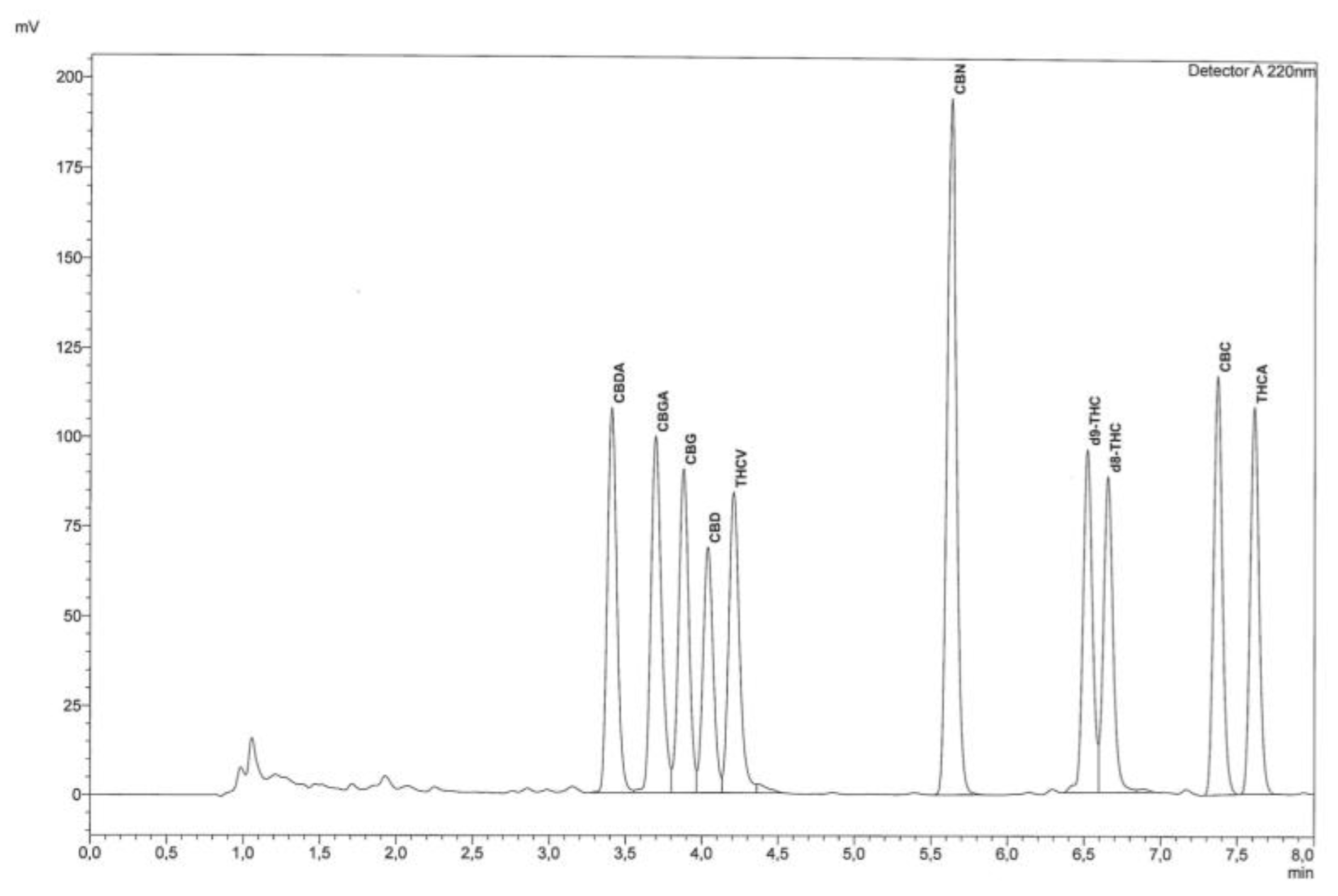
In this 2019 article published in
Molecules, Mandrioli
et al. detail the process they developed for detecting 10 cannabinoids in
Cannabis sativa L. using reversed-phase high-performance liquid chromatography with an ultraviolet detector (RP-HPLC-UV). Citing numerous other published methods, many of them requiring more expensive mass spectrometry detectors, the authors sought to "identify and titrate cannabinoids in a simple way" using a method that optimally would be "fast, easy, robust, and cost-efficient," making the process more approachable by not only research laboratories but also small businesses focused on quality control. Using their method, the authors conclude that the method can produce results in eight minutes, with high sensitivity and simple methodology.


