

Essentials of Genomics and Biomedical Informatics
 This is an IsraelX-created course that is released on the edX platform. The 12-week course "will not make you a bioinformatician but will introduce the main concepts, tools, algorithms, and databases in this field." The course is free to take. A verified certificate of completion is available afterwards for $59 USD. The session started April 2024, and the free Audit track ends August 5.
Data Science: Machine Learning
 This is a Harvard University-created course that is released on the edX platform. The introductory eight-week course will have you "learn popular machine learning algorithms, principal component analysis, and regularization by building a movie recommendation system." The course is free to take. A verified certificate of completion, as part of Harvard's Data Science Professional Certificate Program, is available afterwards for $149 USD. The session started on April 17, 2024 and ends on December 18. Enrollment for the free Audit track ends July 8. An additional session begins on October 16.
Infrastructure tools to support an effective radiation oncology learning health system
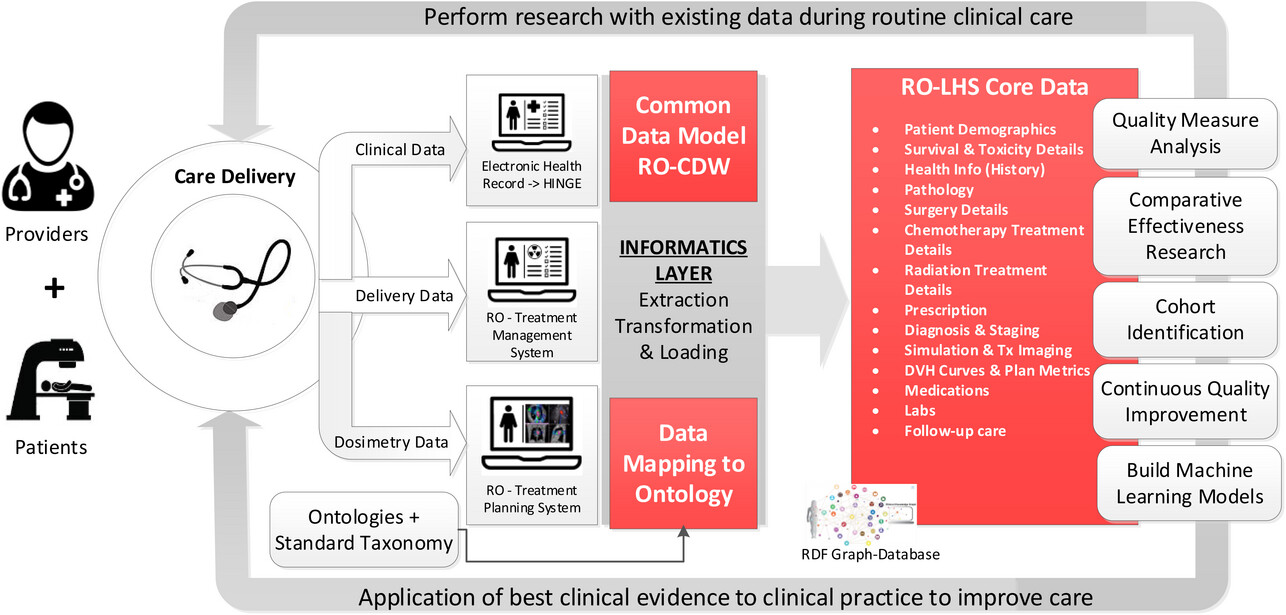 In this 2023 article published in the Journal of Applied Clinical Medical Physics, Kapoor et al. of Virginia Commonwealth University present their approach to managing radiation oncology research data in a FAIR (findable, accessible, interoperable, and reusable) way. The authors focus on the advantages of a knowledge graph-based database combined with ontology-based keyword search, synonym-based term matching, and a variety of visualization tools. After presenting background on the topic, Kapoor et al. describe their approach using 1,660 patient clinical and dosimetry records, standardize terminologies, data dictionaries, and Semantic Web technologies. They then discussed the results of their mapping efforts, as well as the discovered benefits of a knowledge graph-based solution over a traditional relational database approach. They conclude that their approach "successfully demonstrates the procedures of gathering data from multiple clinical systems and using ontology-based data integration," with the radiation oncology datasets being more FAIR "using open semantic ontology-based formats," which in turn helps "facilitate interoperability and execution of large scientific studies."
Healthcare Analytics and Decision Making
 This is a Doane University-created course that is released on the edX platform. The self-paced eight-week course is designed to help learners "[g]ain an understanding of how healthcare informatics is deployed in diverse healthcare systems around the world." The course is free to take, with a Verified Certificate of completion available for $369. (The course is also part of a Healthcare Administration MicroMasters program.) The course began May 2024 and the free audit track expires on July 8.
Data Analytics and Visualization in Health Care
 This is a Rochester Institute of Technology (RIT) course that is released on the edX platform. The eight-week course is designed for students to learn how "to extract, analyze, and interpret data from patient health records, insurance claims, financial records, and more to tell a compelling and actionable story using health care data analytics." The course is free to take, with a Verified Certificate of completion available for $249. The course requires on average eight to 10 hours a week of effort. The next class begins on July 7, 2024, ending November 29. The free audit track will likely expire in early September.
Big Data Analytics
 This is a University of Adelaide course that is released on the edX platform. The ten-week course is designed for students to "learn key technologies and techniques, including R and Apache Spark, to analyze large-scale data sets to uncover valuable business information." The course is free to take, with a Verified Certificate of completion available for $199. This course is also part of Adelaide's Big Data MicroMasters program. The course requires on average eight to ten hours a week of effort. Access to the class began in May 2024, and the free audit track is open until July 22.
Cybersecurity Risk Management
 This is a Rochester Institute of Technology-created course that is released on the edX platform. The introductory eight-week course is designed to help learners "learn about the general information security risk management framework and its practices and how to identify and model information security risks and apply both qualitative and quantitative risk assessment methods." The course is free to take. A verified certificate of completion, via a Verified track from RIT, is available for $399 USD. The class starts July 7, 2024 and runs until September 1 when the free audit track expires.
Request for Bids: Water testing and analysis
Solicitation #: AT-2024-4
The City of Camarillo, California is seeking bids for the laboratory testing of “potable water, recycled water, and Desalter samples. The qualified firm must be ELAP or NELAP certified to perform testing on water samples utilizing appropriate methodologies to satisfy the California State Water Resources Control Board (SWRCB) and United States Environmental Protection Agency (US-EPA).”…
Webinar: A deep dive into hydrogen fuel analysis for a cleaner future
“Dive into the heart of hydrogen fuel analysis in our upcoming webinar, where Dr. Kiran Piduru, market development specialist, Markes International, will uncover the hidden impurities in this vital clean energy source. These impurities not only hinder fuel cell efficiency but also raise pollution concerns, emphasizing the need for rigorous testing methods like ISO 14687 and ASTM 7892.…
Request for Quote: Sentinel Biological Sample Testing
Solicitation #: 36C24E24Q0048
“The San Francisco VA Medical Center requires biological/environmental sample testing from blood, feces, fur swab (sentinel method), and/or sample substrate (SFSB method) … Sentinel (blood, feces, fur swab), or SFSB (sample substrate) samples are collected by VA VMU staff, animal caretakers, and shipped to the contractor for testing four times a year for sentinels or SFSB and on an “as needed” basis for animal imports/exports.…
Request for Proposal: Electronic Quality Management System (eQMS) For State Public Health Laboratory (SPHL)
Solicitation #: BD-24-1031-ADMIN-ADM07-101197
“The Commonwealth of Massachusetts Department of Public Health (MDPH), Bureau of Infectious Disease and Laboratory Sciences (BIDLS) is seeking proposals from qualified bidders for an electronic Quality Management System (eQMS) for the Massachusetts State Pubic Health Laboratory (MA SPHL).…
Request for Proposals: Water and Wastewater Laboratory Testing Services
Solicitation #: RFP-63979
“The Town of Front Royal, Virginia is soliciting sealed proposals from qualified Offerors to establish a term contract or contracts through competitive negotiations to furnish physical, chemical, and bacteriological laboratory services for the Water Treatment Plant and Wastewater Treatment Plant for the Department of Public Works for the Town of Front Royal.”…
Laboratory Informatics Weekly Update – Volume 22, Issue 19
May 9, 2024 Laboratory Informatics Weekly Update Volume 22, Issue 19 In This Issue Featured Books The Complete Guide to LIMS and Laboratory Informatics - 2024 Edition Featured Content Are You Happy with Your LIMS?In today’s fast-paced scientific landscape, Laboratory Information Management Systems (LIMS) play a pivotal role in ensuring the efficiency and accuracy of laboratory operations. From biotech companies to environmental agencies, the use of a LIMS can significantly influence the workflow and overall productivity of a laboratory. However, as with any technology, the satisfaction levels can vary significantly among users. Are you truly happy with your current…Are You Happy with Your LIMS?
 In today’s fast-paced scientific landscape, Laboratory Information Management Systems (LIMS) play a pivotal role in ensuring the efficiency and accuracy of laboratory operations. From biotech companies to environmental agencies, the use of a LIMS can significantly influence the workflow and overall productivity of a laboratory. However, as with any technology, the satisfaction levels can vary significantly among users. Are you truly happy with your current LIMS? This article explores various facets of LIMS satisfaction, helping you evaluate your system against industry benchmarks and personal expectations. [Read More]
Strategies for Harnessing AI-Ready Chemical Data in Drug Discovery
 In drug discovery, artificial intelligence (AI) and machine learning (ML) technologies have significantly changed the way researchers analyze and interpret chemical data. From molecular modeling to predicting drug responses, AI-driven approaches offer opportunities to expedite the drug development process. To unlock the full potential of AI in drug discovery, however, it is imperative to lay a strong foundation with properly structured and high-quality chemical data. In this blog, we explore key strategies for preparing AI-ready chemical data and maximizing its utility in drug discovery endeavors. [Read More]
Sapio Sciences Unveils Enhanced Molecular Biology Toolkit
 Sapio ELN release 24.5 features multiple improvements, including enhanced CRISPR design with multiple sequence alignment and integration with small molecule research. [Read More]
Advancing Quality Control Testing in Therapeutic Biologics
 Quality control (QC) testing is paramount in ensuring the efficacy and safety of therapeutic biologics. These complex molecules, derived from living organisms, require stringent testing to meet regulatory standards and ensure patient safety. While state-of-the-art molecular methods have been established, many laboratories still rely heavily on animal testing, using protocols developed in the 1970s. In November 2023, the International Council for Harmonisation (ICH) announced the adoption of guidelines encouraging the biopharmaceutical industry to adopt new standards in biologics QC, including next-generation sequencing (NGS)-based assays. [Read More]
Unlocking the Power of AWS for LIMS
 Cloud computing has transformed the way organisations and laboratories manage their data, providing online access and storage that eliminates the need for local computer storage, especially recently. This innovation has been particularly beneficial for laboratories, offering a secure, scalable and cost-effective solution for managing laboratory data. Let’s dive into AWS for LIMS (Laboratory Information Management Systems) together. [Read More]
Frequently Asked Questions About the Labstep ELN
 Last year, STARLIMS revealed momentous news in our 36+ year history. We announced the strategic acquisition of Labstep—and their cutting-edge Electronic Lab Notebook (ELN)—to expand our solution portfolio. Read below for answers to our most Frequently Asked Questions about the acquisition and what it means for STARLIMS—and your—future. [Read More]
Navigating the Complexities of Informed Consent Writing: Tips and Strategies for Clinical Researchers
 Clinical research involving human subjects is crucial for the development of new treatments, drugs, and therapies, but it must be conducted in an ethical manner that protects the rights and well-being of the participants. Informed consent is the cornerstone of ethical research, requiring that participants or donors are provided with sufficient information about the study to make an informed decision about whether to participate or not. [Read More]

