

Automation in Farming Can Forever Change the Agriculture Industry
 As if the looming need to feed the world’s growing population were not enough, farmers are dealing with many other challenges in sustaining their business. Farm automation can help the agriculture industry meet the needed increase in production, while at the same time solving labor shortage problems and allowing for increased care of the environment. Farm-focused agriculture labs can assist with soil and seed analysis, among other things, and utilize the data captured by drones and crop sensors to provide recommendations for crop rotation, fertilizer adjustments, or new pesticide treatments. [Read More]
How Logilab SDMS helps Laboratories to enable 21 CFR Part 11 Compliance: Part 2
 Agaram Technologies’ Logilab SDMS is a generic software application designed to handle scientific instrument data from any analytical instrument and can facilitate data management with access control. Logilab SDMS will perform scheduled data capture, cataloguing, archival and facilitate restoring data and has capabilities to extract data of interest from instrument output to be pushed to external systems like Electronic Note Book (ELN), Laboratory Information Management System (LIMS) and Enterprise Resources Planning (ERP). [Read More]
Composable Architecture’s Impact on a Digital Transformation of Life Sciences
 Composable Architecture shifts the focus from monolithic application suites and hosting to use of best of breed solutions as part of a unified platform-ecosystem. By leveraging business architecture, technologies, and agile thinking, organizations can speed discovery, gain greater agility, and enable flexibility to handle future changes. Many organizations find that the fundamental components to enable Composable Architecture are already in place. [Read More]
Technical Consultant
Interested in LIMS and live in the USA? Are you a US citizen?
Want to help Laboratories make the most of their informatics systems?
We continue to grow our technical team in 2022. Our LIMS solutions are unique. Based on a Low-Code Development Platform (LCDP) concept, since since 1996 we have been configuring LIMS solutions without the need for software programming skills.…
Senior Software Developer – Remote, UK
Autoscribe Informatics is seeking to strengthen its Development team and invites candidates to apply for the role. The successful candidate will be involved in the design of software systems for a sophisticated and complex LIMS application.
This is a fantastic opportunity to join a fast growing Company; you will be involved in the delivery of innovative software at the cutting-edge of the industry.…
Technical Sales Consultant – Software West Coast Territory
Autoscribe Informatics is looking for a strong, well accomplished, Sales Consultant to join the sales team of our fast growing software and services informatics company. (Office or Remote).
For a detailed job description please see our website:
https://www.autoscribeinformatics.com/about-us/careers
Key Required Skills:
- Experience selling software and services into scientific laboratories
- Keen understanding of laboratory workflows
- Ability to sell complex software systems
- A strong background / success in selling
…
Laboratory Informatics Weekly Update – Volume 20, Issue 48
November 30, 2022 Laboratory Informatics Weekly Update Volume 20, Issue 48 In This Issue Featured Content 12/07/2022 - LIMS Selection Workbook for All LaboratoriesWhen planning a project of any type, it makes perfect sense to initially research and detail the specifics of the project to lay a solid foundation to work from. This is particularly true with software development, where careful initial planning is vital to ensuring the project is legitimate in the eyes of critical stakeholders and will meet specified goals. This demands the creation of a software requirements specification. Many specification documents for laboratory informatic systems have…Recommendations for achieving interoperable and shareable medical data in the USA
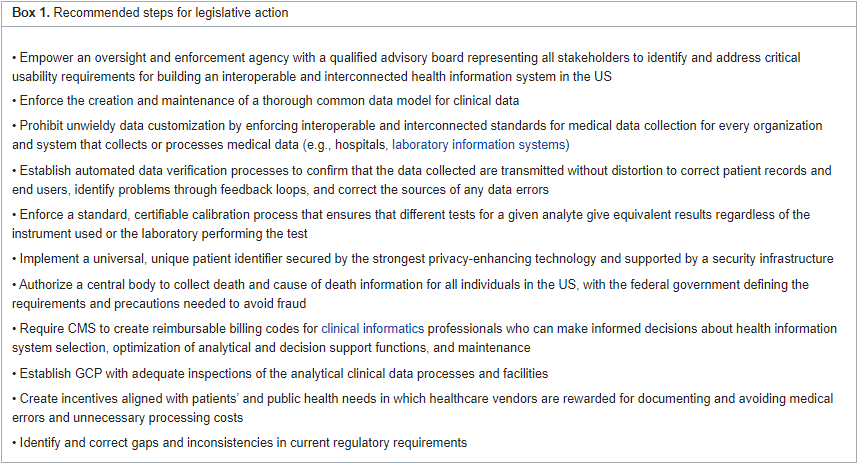 Interoperable health information systems in the United States has been a long-road effort that, according to Szarfman et al., has a long way to go yet to reach its full potential. Noting the strain on the digital health systems of hospitals, physician offices, laboratories, and other entities during the COVID-19 pandemic, the authors—many of them from the U.S. FDA—"recommend the implementation of standardized data collection and transmission systems, universal identifiers for individual patients and end users, a reference standard infrastructure to support calibration and integration of laboratory results from equivalent tests, and modernized working practices" in this brief paper. After providing a contextual introduction, they discuss the lack of universal and harmonized data collection and transmission standards and highlight five major issues with modern health systems that need immediate action. After briefly discussing return on investment in adopting the authors' recommendations, they conclude by posting 11 recommendations for U.S. legislators and nine recommendations for public-private partnerships in addressing the issues of health systems interoperability in the United States. They close by noting that while "this problem will not be cheap to fix ... it will be much costlier to ignore."
Pooled Sample Testing in LIMS
 Pooling samples and testing the resulting single sample can help laboratories improve productivity, reduce reagent use, and cut costs. Pool-testing can be used to increase throughput if testing resources are limited or during times of increased demand.
Sample pooling is used in many industries. [Read More]
Informatics in the Agriculture Industry
 As automation continues to work its way into agriculture, large farms are using robotic farm equipment for much of the work that had been done by people. Computing and information technology have a significant role to play from guiding tractors around fields, advising farmers on what crops to plant given forecasted weather conditions and consumer demand, managing communications, and maintaining records and data. Our interests in this article are going to focus on computing and information technology in the realm of agriculture research and laboratory testing.[Read More]
CSols Summit Recap: Exploring the Future of Lab Data Across Your Organization
 When technology changes, you must change with it. If not, your business could fall behind. Organizations can be easily swayed by new technology buzzwords such as digital transformation and AI/ML for the laboratory, without really understanding what will be required to enact that technology. As a consultancy to a wide range of companies, it is our business to stay at the forefront of laboratory innovation, learn all that we can about what the future may be, and share those learnings with our audience. [Read More]
Pistoia Annual Conference 2022 – Conference Recap
 Astrix participated as the Networking Reception Sponsor at the Pistoia Annual Conference in Boston, MA on Nov 1-2, 2022. This event had over 225 life sciences R&D representatives from many of the largest Pharma companies. Participants from Astrix included individuals from our Lab Information Systems group, Strategic Consulting Services group, and Marketing. [Read More]
How Logilab SDMS helps Laboratories to enable 21 CFR Part 11 Compliance Part 1
Title 21 CFR Part 11 is the part of Title 21 of the Code of Federal Regulations that establishes the United States Food & Drug Administration (FDA) regulations on electronic records & electronic signatures (ERES). Part 11 sets out how a company operating in the US can use electronic quality records & digital signatures in place of paper-based documentation & ‘wet signatures’ in such a way that complies with FDA regulations. [Read More]
4 Tips to Writing Job Descriptions
 When writing job descriptions, there are seemingly little-known techniques that can turn your job postings into irresistible magnets for the right candidates. If you’re seeking quality over quantity and prefer to hire for longevity, then these four insider tips can shorten the interval between getting the attention of – and obtaining —the talent who’ll happily choose your organization. [Read More]
Laboratory Informatics Weekly Update – Volume 20, Issue 47
November 23, 2022 Laboratory Informatics Weekly Update Volume 20, Issue 47 In This Issue Featured Content 11/23/2022 - LIMS Selection Workbook for All LaboratoriesWhen planning a project of any type, it makes perfect sense to initially research and detail the specifics of the project to lay a solid foundation to work from. This is particularly true with software development, where careful initial planning is vital to ensuring the project is legitimate in the eyes of critical stakeholders and will meet specified goals. This demands the creation of a software requirements specification. Many specification documents for laboratory informatic systems have…Sr Scientist / Analytical Chemistry – Center for Anti-Infective Research and Development
Sr Scientist / Analytical Chemistry – Center for Anti-Infective Research and Development
Work where every moment matters.
Every day, almost 30,000 Hartford HealthCare employees come to work with one thing in common: Pride in what we do, knowing every moment matters here.…
Can a byte improve our bite? An analysis of digital twins in the food industry
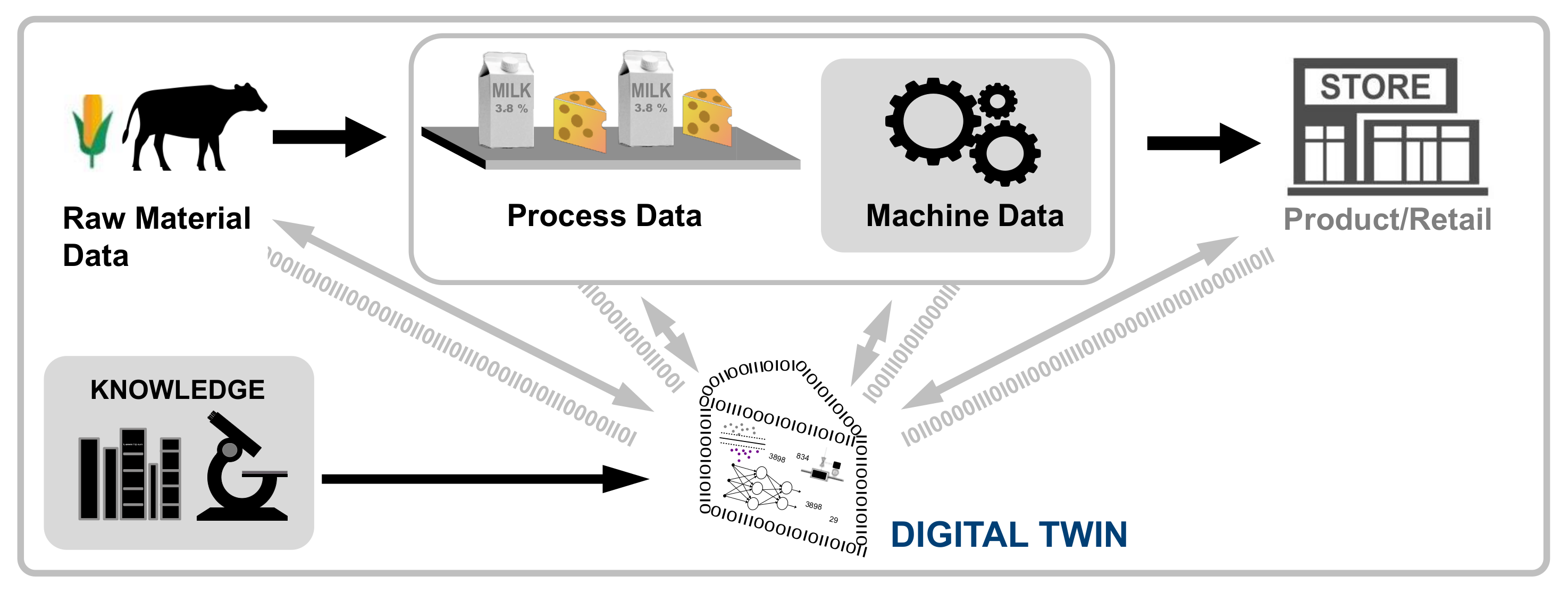 In this 2022 paper published in Sensors, Henrichs et al. of the University of Hohenheim present their literature review on the topic of digital twins in the food and beverage industry. The concept of the digital twin—a digital representation of a product, process, or system that as closely as possible represents the characteristics of the physical representation—is relatively new, and its use in the food and beverage industry holds much promise, according to the authors' research. After an introduction and extensive background, the authors provide the methodology for their review, focusing on six critical questions. They then present their results from a broad perspective, and then a more in-depth discussion focusing on answering those six questions. They close by emphasizing related work in the field, and then concluding that while a majority of the research conducted by others involves the production and processing stages of food and beverage activities, a dearth of cases appear to discuss supply, processing, retail, and consumption. They also note that "relatively few focus on the integration of digital twins in systems for developing autonomous control or providing recommendations to humans," which could be practically useful in the industry. "Nevertheless, digital twins provide huge potentials," they add, "e.g., in determining food quality, ensuring traceability, or designing personalized foods."
Informatics in R&D
 In an earlier article1, we looked at the role laboratory information management systems (LIMS) played in manufacturing/production operations, as well as their relationship to other control/database systems. This article is going to shift the focus to the source of those manufactured/production operations: research and development. [Read More]
LIMS Data Analytics Discussed in Autoscribe Webinar
 One of the many benefits of a Laboratory Information Management System (LIMS) is that all laboratory data is captured in one place. This allows laboratories to easily extract Key Performance Indicators (KPIs) and detailed management statistics from the data, providing a rich source of information to optimize operations and eliminate wastage. Yet few laboratories take maximum advantage of this capability. [Read More]
How Logilab SDMS helps Laboratories to enable GLP Compliance – Part 4
GLP lays down a very important principle that the data captured or entered in the system must be accurate. In order to ensure accuracy, GLP necessitates computerized system must have the capability to validate, verify and filter the data for accuracy. Logilab SDMS ensures that users can verify the data that is captured from the instruments can go through a workflow process. [Read More]

