

Leveraging conservation action with open‐source hardware
 Researchers in a wide variety of fields are gradually realizing the benefits of open-source hardware (OSH) in their scientific activities, though not easily. Projects associated with OSH often fail for lack of technological know-how, long-term funding, and strong organization. In this 2019 article, Hill et al. suggest the benefits of "a provisional framework for developing and sustaining the life cycle of not‐for‐profit OSH," in this case applying it to their biological and conservation science. The authors describe their six-phase framework spread across two management teams, one for engineering and one for logistics (with both sharing social media and outreach duties). They present as a case study the AudioMoth project for the development of a low-cost, full-spectrum acoustic logger, which was largely crowd-sourced. They conclude by emphasizing the importance of frameworks such as theirs, stating that without them "existing OSH will continue to have short life spans, and remain out of reach for the majority of conservation biologists." More broadly, they also note the need "to push access to OSH toward communities outside of the pockets of wealth and high opportunity that the framework may initially serve."
National Institutes of Health (NIH) Research and Upcoming Events – February 2020
 As part of the U.S. Department of Health and Human Services, the National Institutes of Health (NIH) is our nation’s medical research agency and strives to make important discoveries that improve health and save lives. Founded in 1870, the NIH conducts its own scientific research through its Intramural Research Program (IRP), which supports approximately 1,200 principal investigators and more than 4,000 postdoctoral fellows conducting basic, translational and clinical research. The NIH also provides biomedical research funding for non-NIH research facilities via its Extramural Research Program, investing nearly $39.2 billion in external medical research in 2019.
In a study conducted by the Nature Index in 2019, the NIH ranked #2 in the world in terms of published scientific papers, behind only Harvard University in Boston. In this blog, we will highlight recent ground-breaking research that has been conducted through the NIH IRP, while also providing links to upcoming NIH events designed to keep researchers abreast of the latest discoveries.
[Read More]
Business Benefits of a LIMS
 Ensuring regulatory compliance, reducing errors, streamlining workflows and enabling growth through the introduction, consolidation and integration of IT systems will ultimately pay dividends for the business and help achieve a competitive advantage. However, for many reasons including lack of resources, no formal business plan or the difficulty of articulating the potential business benefits, laboratories often struggle to drive the introduction and modernization of IT solutions in their laboratories.
Autoscribe Informatics works with companies worldwide to improve business efficiency. Our Matrix Gemini Laboratory Information Management System (LIMS) drives consolidation, improves data integrity and increases laboratory efficiency. Laboratory process automation and workflow management can reduce transcription errors, improve turn-around times, and increase resource utilization; and these are just a few of the business benefits associated with adopting a LIMS.
[Read More]
Laboratory Informatics Weekly Update – Volume 18, Issue 5
February 4, 2020 Laboratory Informatics Weekly Update Volume 18, Issue 5 In This Issue Upcoming Webinars 02/11/2020 - Webinar: Protecting Healthcare Institutions from Cyber Attacks02/19/2020 - Webinar: Operationalizing Business Associate Risk Management for Compliance with HIPAA Regulation02/19/2020 - Webinar: LIMS Instrument Interfacing – The Times They Are A-Changing02/27/2020 - Astrix Webinar – Best Practices for Conducting Data Integrity Assessments Journal Articles One tool to find them all: A case of data integration and querying in a distributed LIMS platformIn this early 2019 journal article published in the journal Database, Grand et al. of the Candiolo Cancer Institute present the…Water Outlook integration added to QLIMS
 OnQ Software is pleased to announce the release of our new off the shelf integration to WaterOutlook, an operational data management system, to combine lab results with data from SCADA and field staff.
The addition to our integrations catalogue allows customers to maximise the use and benefits of both LIMS and WaterOutlook by allowing data to transfer securely and easily between the two. They may then use the data to make better decisions while having the peace of mind that the integration is fully supported.
[Read More]
Considerations for Cloud Hosting Your Laboratory Informatics Systems
Traditional on-premise informatics systems in scientific laboratories are often accompanied by significant operational costs – securing the data, applying patches, providing backup and disaster recovery, hardware maintenance, etc. Public, multi-tenant cloud-based systems accessed “as a service” share infrastructure across several customers and deliver value by managing those systems with shared resources and procedures that drive efficiency. For customers, costs are accrued as a monthly operating expense as opposed to a capital-intensive purchase that requires months of planning.
While the public cloud software as a service (SaaS) model is well established, there are other cloud computing models.
[Read More]
The role of LIMS in digital transformation strategies
Digital transformation uses digital technologies throughout an organization to fundamentally improve or change how businesses operate and provide value to their customers. Digital transformation may encompass multiple systems and technologies including robotics, workflow automation, advanced data analytics, artificial intelligence (AI) and Cloud technologies. While this may require the implementation of new systems there is great potential for improvement by applying the ideas to existing systems. Digital transformation is a natural extension of the so-called fourth industrial revolution, and as such requires seamless multi-directional flows of data and information from every facet of the business. This creates a data ecosystem characterized by complex relationships. Done correctly this has the potential to link tacit data (data known only to a single person), and group data or tribal data (data known to a limited number people often within a single team) to help create and protect that most valuable resource – corporate knowledge. Nowhere are these ideas more applicable than in the laboratory environment.
[Read More]
Future Advances in LIMS and ELN Technology
 The human construct of time provides us with a frame of reference for discussing a sequence of events. It helps our consciousness make sense of the physical world around us. In some schools of thought, the future doesn’t exist. As scientists, engineers, and laboratory informatics professionals, however, it’s your job to plan for the future, if not to chart a path for getting there.
In the run-up to New Year’s Day, we saw many retrospective takes on what changes the last decade brought. In this blog post, we’ll take a look at some possible advances that the coming decade might bring to the world of laboratory informatics. In almost all of the writing that has already been done about the Lab of the Future, data has a central role. As informatics consultants, we can’t disagree with this assessment.
[Read More]
Laboratory Informatics Weekly Update – Volume 18, Issue 4
January 28, 2020 Laboratory Informatics Weekly Update Volume 19, Issue 3 In This Issue Upcoming Webinars 02/11/2020 - Webinar: Protecting Healthcare Institutions from Cyber Attacks02/27/2020 - Astrix Webinar – Best Practices for Conducting Data Integrity Assessments Journal Articles A security review of local government using NIST CSF: A case studyIn this 2018 article published in The Journal of Supercomputing, Ibrahim et al. present the results of their application of the National Institute of Standards and Technology's (NIST) Cybersecurity Framework to a custom assessment tool for gauging the cybersecurity preparedness of an organization. In this paper, the authors used their…A security review of local government using NIST CSF: A case study
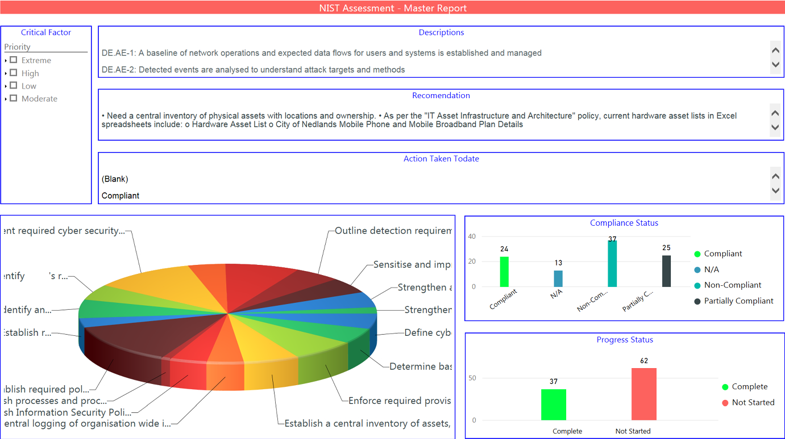 In this 2018 article published in The Journal of Supercomputing, Ibrahim et al. present the results of their application of the National Institute of Standards and Technology's (NIST) Cybersecurity Framework to a custom assessment tool for gauging the cybersecurity preparedness of an organization. In this paper, the authors used their assessment tool to assess a Western Australian government. After discussing the formula involved with the assessment tool and visualization of results using Microsoft Power BI, the authors conclude that using their tool and the NIST Cybersecurity Framework, organizations can better "identify the specific people, processes, and technology areas that require improvement" and improve threat mitigation. The authors also cite the user-friendly nature of the framework.
2019 Lab Informatics Year in Review
Since 1995, Astrix Technology Group has been serving the scientific community by helping our customers improve laboratory business processes, source the right talent, and harmonize quality processes by employing the right technology. Our core mission is to build value and trust with the clients we serve, and ultimately help our customers do the important scientific work that improves the world we live in.
2019 was a really great year for Astrix. Over this past year, we doubled our practice servicing federal agencies, reached an important milestone of 750 total employees, and grew by an amazing 34%. Along the way, we added new services, conducted industry surveys, produced helpful white papers and blog posts, sponsored and gave presentations at several important industry conferences, and provided a number of information-packed webinars to support the scientific community. Let’s take a closer look at some of our key contributions and achievements which helped make 2019 such an exciting year for the Astrix family.





